Stahlherz

The new album

Therapiesitzung

Therapy Session

To the album

We are more than twelve years.

"Therapiesitzung" (Therapy Session) tells the story of Germany as one single conversation on the couch. A man winds up his grandmother's music box and begins to talk: about the first spark in a workshop in Mainz, about poets, thinkers and barricades, about inventors in backyard workshops.

Then about the fire that burned everything, and about the guilt that remains. About rubble that became cities again, about decades of silence, and about candles that brought down a wall. And finally about the moment when you stand upright again.

We forget none of these years. And still we are proud.

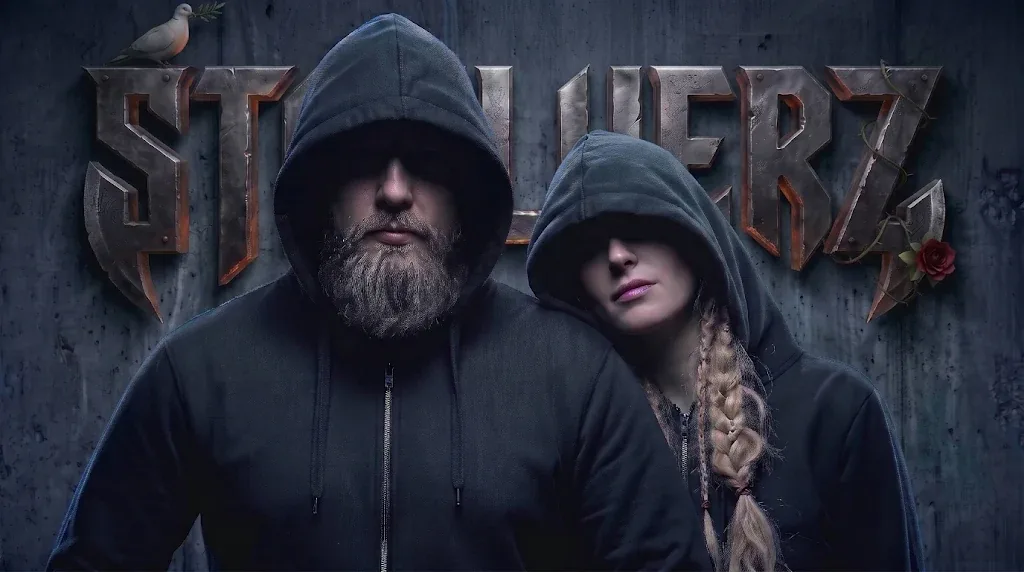
Stahlherz: two figures in black hoodies in front of a concrete wall with the band logo

Act I

Spark

The Rise

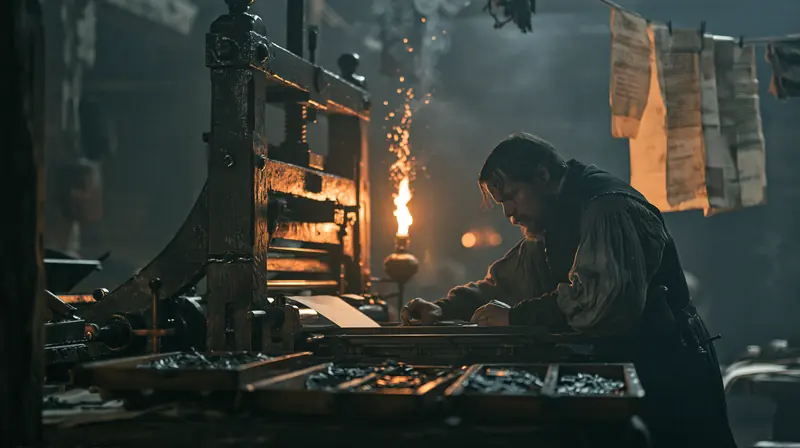
A printing workshop around 1450, a single spark in the night

Act I / around 1450

Funke

Spark

The story

Around 1450, Johannes Gutenberg developed printing with movable metal type in Mainz. Until then, books were copied by hand. They were expensive, rare and out of reach for most people.

With the printing press, knowledge could suddenly be copied quickly and cheaply. Within a few decades, books and pamphlets spread across all of Europe. Later, printed Bibles in German helped shape many dialects into one shared written language.

What we want to say

The song tells of the first spark: an invention that set the word free. This is where the line begins that runs through the whole album: "Aus einem Funken wird ein Feuer" (From a spark comes a fire). The bridge already hints that the same fire will one day also destroy.

Lyrics (English translation)

Verse 1 Him

There was a time
When the word was made of gold
Written out by hand alone
Meant only for the few
The nights were long
The light was weak and small
Until into a workshop
A single spark would fall

Pre-chorus Her

A spark leapt into lead
Iron turned into type
The word was free at last
For everyone it finds

Chorus Both

One spark is enough (One spark is enough)
For a whole land
One spark is enough (One spark is enough)
From a single hand
From a spark comes a fire
From a fire comes a light
And this light
Never dies

Verse 2 Her

The pages flew faster
Than any rider rode
Through cities, over borders
And everyone took them along
The farmer and the smith
The maid by candlelight
Out of a hundred dialects
One language comes to be

Pre-chorus Him (repeat)

Chorus Both (repeat)

Bridge Him, spoken

Remember this spark
It will warm houses
It will drive machines
It will carry songs
And one day
It will burn
Where it must never burn

Chorus Both (repeat)

Outro Her, whispered

One spark is enough

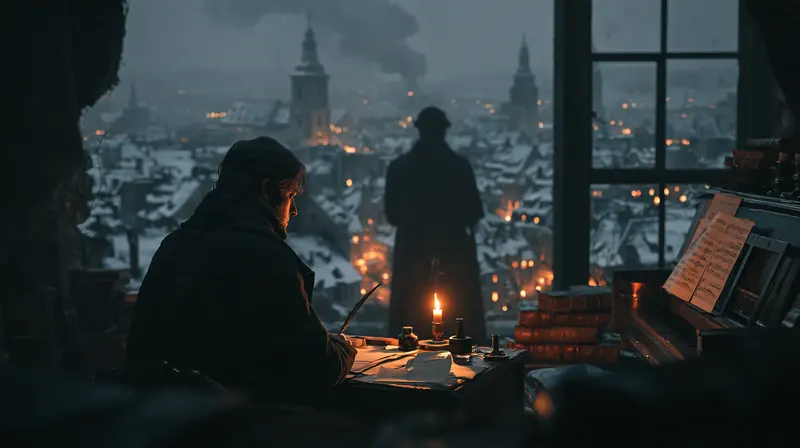
A study by candlelight with quill, sheet music and books

Act I / around 1800

Dichter und Denker

Poets and Thinkers

The story

Around 1800, Germany did not exist as a state. The Holy Roman Empire consisted of hundreds of principalities, bishoprics and free cities, each with its own borders and customs duties. In 1806 it dissolved.

What still connected people was culture: a shared language, literature, philosophy and music. Works were created in this period that are still read and performed all over the world today. Beethoven wrote his Ninth Symphony when he was already almost deaf. The melody of its final movement, the "Ode to Joy", is today the anthem of Europe.

What we want to say

Germany was a song before it was a country. The shared identity did not come from war, but from language, ideas and music. This line is one of the foundations of the album, and it makes the break that comes later all the more painful.

Lyrics (English translation)

Verse 1 Her

No empire and no crown
Just borders, tolls and thrones
A land in a hundred pieces
And each one with its own
But over every wall
And every barrier gate
The very same language flew
And carried the same meaning

Pre-chorus Him

No king gave us a name
No sword gave us a face
We found ourselves in notes
In verses and in poems

Chorus Both, choir

Poets! (And thinkers!)
Quill and sound
We were a song
Before we were a land
Poets! (And thinkers!)
Ink and light
From a spark comes a fire
And this fire speaks

Verse 2 Him

They asked about the heavens
They asked about what's right
About freedom and dignity
About master and servant
In chambers without stoves
By candlelight till dawn
They wrote what the world
Still reads and speaks today

Pre-chorus Her (repeat)

Chorus Both, choir (repeat)

Bridge Him, spoken

A melody
Written by a man who could not hear it himself
Went around the world
And today it is sung
By an entire continent

Chorus Both, choir (repeat)

Outro Her

Guard this fire

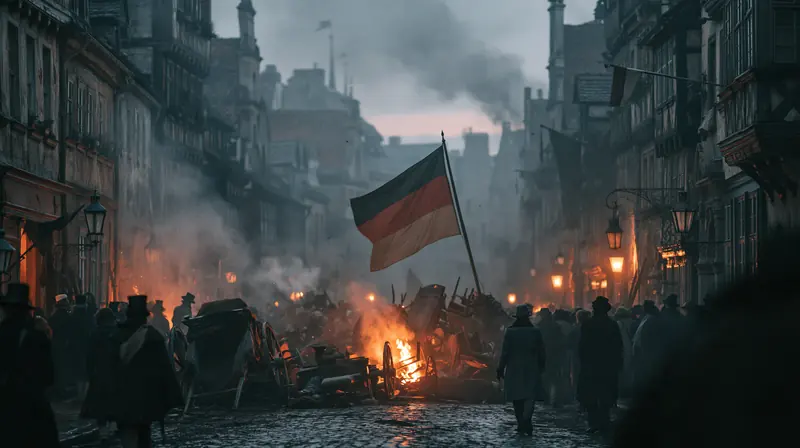
A barricade at dawn, black, red and gold in the wind

Act I / 1848

Achtundvierzig

Forty-Eight

The story

In March 1848, people took to the streets in many German states. Craftsmen, workers and students built barricades in Berlin, Vienna and other cities. They demanded freedom of the press, freedom of speech, a constitution and a united Germany instead of dozens of separate states.

In May 1848, the first freely elected all-German parliament met in St. Paul's Church in Frankfurt and wrote a constitution with fundamental rights for everyone. In 1849 the princes, above all Prussia and Austria, crushed the revolution with military force. Many revolutionaries fled, most of them to America.

But their ideas survived. They found their way into the Weimar Constitution of 1919 and into the Basic Law of 1949. Black, red and gold, the colors of the movement, are today the colors of the German flag.

What we want to say

For the first time on the album, something is crushed and still keeps glowing. This is the blueprint for everything that follows. The line "die uns den Mund verbieten" (who forbid us to speak) was meant literally in 1848, and every listener will also relate it to today.

Lyrics (English translation)

Intro Choir

Black! Red! Gold!
Black! Red! Gold!

Verse 1 Him

In March the ice broke
And the alleys grew loud
The cobbler and the student
Built barricades
They had no cannons
Only cobblestones and courage
And a flag of three colors
Sewn from hope and rage

Pre-chorus Her

We want no masters
Who forbid us to speak
We want free words
And a land at peace

Chorus Both, choir

Black! (Black!)
The night we walk through
Red! (Red!)
The embers burning in us
Gold! (Gold!)
The morning that we see
Forty-eight
And no one tears us apart

Verse 2 Her

In a church without a sermon
No prince sat, the land sat there
They wrote down our rights
For the first time by their own hand
But the crowns struck back
With sabres and with lead
And many fled across the sea
But their thought stayed free

Pre-chorus Him (repeat)

Chorus Both, choir (repeat)

Bridge Him, spoken

They lost
Say the books
But a hundred years later
Their rights stood in our law
And their colors
Over our roofs

Bridge Her

You can crush an uprising
But not a thought
Remember that

Breakdown Choir

Black! Red! Gold!
Forty-eight!

Chorus Both, choir (repeat)

Outro Her, whispered

But not a thought

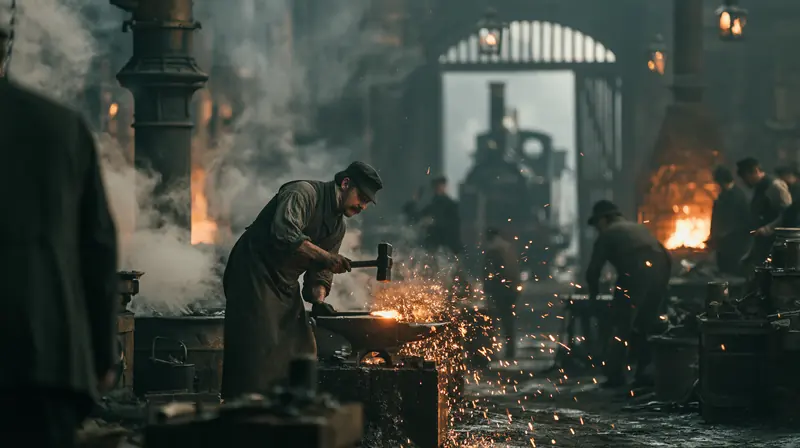
Sparks above the anvil, steam and an early locomotive

Act I / 19th century

Werkstatt

Workshop

The story

In the 19th century, industrialization changed Germany fundamentally. In 1835 the first German railway ran between Nuremberg and Fürth, and soon tracks connected the many separate states.

Workshops and backyards produced inventions that changed the world: the dynamo, the refrigeration machine, the automobile, X-rays, aspirin. At the same time, many people worked under harsh conditions in factories and mines.

In the 1880s the German Empire introduced health, accident and pension insurance. A social insurance system of this kind had never existed anywhere in the world before.

What we want to say

A song about tinkerers who were laughed at, and about hands that do not lie. This is where the band name appears for the first time: "Aus dem Feuer wird Stahl, aus dem Stahl wird ein Herz" (From the fire comes steel, from the steel comes a heart).

Lyrics (English translation)

Verse 1 Him

In the backyard a light burns
Deep into the night
A vice, a file
And a dream that stays awake
They laughed at wagons
That roll without a horse
They laughed until the whole world
Was driving in those wagons

Pre-chorus Her

No gold in our pockets
Only soot on our face
All we had were our hands
And hands don't lie

Chorus Both, choir

Fire! And steel!
Blow by blow
Fire! And steel!
Night and day
From a spark comes a fire
From the fire comes steel
From the steel comes a heart
(A heart of steel!)

Verse 2 Her

The rails stitched pieces
Into one whole land
What princes never united
Was now held by an iron band
In halls full of steam
Stood woman and man
And whoever worked themselves sick
No longer fell into nothing
For the first time on earth
A net of rights and duty

Pre-chorus Him (repeat)

Chorus Both, choir (repeat)

Bridge Him, spoken

A wagon without a horse
A light that sees through bones
A pill against the pain
Cold from a machine
Power from a coil
All from workshops like this one

Bridge Her

And the whole world bought it
With a stamp on it

Breakdown Choir

Fire! And steel! Fire!
A heart of steel!

Chorus Both, choir (repeat)

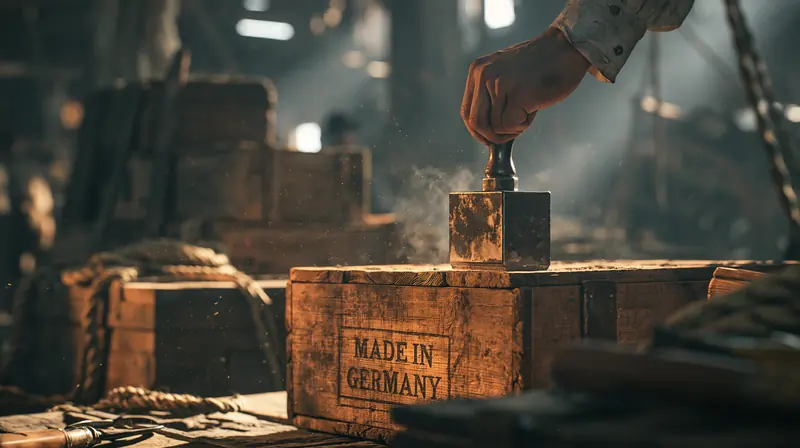
An iron stamp on a wooden crate: Made in Germany

Act I / 1887

Der Stempel

The Stamp

The story

In 1887 the British Parliament passed the Merchandise Marks Act. From then on, imported goods had to show where they came from. It was meant as a warning: customers were supposed to recognize and avoid cheap imports from Germany.

It turned out differently. German manufacturers improved quality and workmanship, and the label "Made in Germany" became a worldwide sign of reliability. The mark of shame became one of the best-known seals of quality in the world.

What we want to say

A stamp is only what you make of it. The song is the triumphant high point of the first act. But at the end the mood tips over: the feeling of being invincible is the beginning of the fall.

Lyrics (English translation)

Verse 1 Her

Over there across the water
They complained
Too cheap and far too many
And supposedly worth nothing
They wrote a law
In ink, cold and clear
On every piece a mark
So you can see who made it

Pre-chorus Him

A mark of shame on the goods
A brand upon the land
They thought that they had marked us
But they didn't know the hand

Chorus Both, choir

Press it on! (The stamp!)
On steel and on wood
What was meant as shame
We wear with pride
Press it on! (The stamp!)
On every piece in the land
Made in Germany
By our own hand

Verse 2 Him

But then came what no one
On the island ever thought
The customers searched for the mark
By day and by night
What was meant to warn, attracted
What was meant to divide, bound
The mark of shame became a seal
In every foreign land

Pre-chorus Her (repeat)

Chorus Both, choir (repeat)

Bridge Him, spoken

Remember this
A mark is only
What you make of it
They can press a stamp on you
But what it means
Is up to you

Bridge Her, whispered

Made in Germany

Bridge Him

And we were proud
And we thought
Nothing in this world
Could ever break us

Breakdown Choir

Made! In! Germany!
By our own hand!

Chorus Both, choir (repeat)

Act II

Fire

The Fall

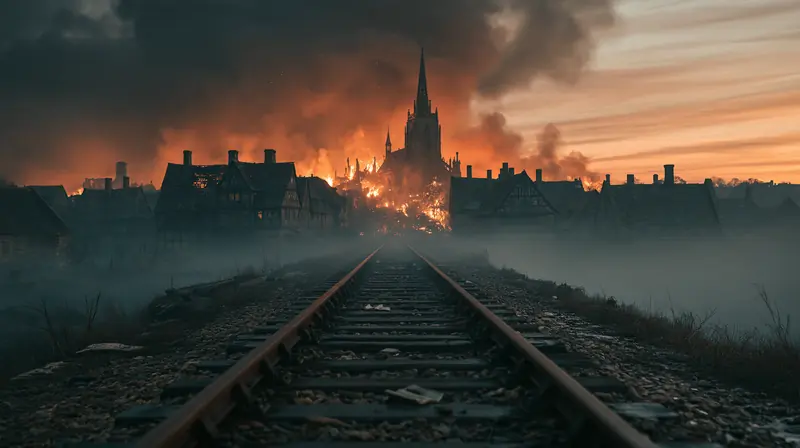
A burning old town at night, a railway track in the fog

Act II / 1933 to 1945

Asche

Ashes

The story

During the economic crisis of the early 1930s, the National Socialists won more and more support with promises and images of enemies. In 1933 they came to power and established a dictatorship within a few months. In May 1933, books were burned in public squares.

Jewish people were stripped of their rights step by step. From 1938 their passports were stamped with a "J", and from 1941 they had to wear a yellow star. In the Holocaust, around six million Jews were murdered, along with Sinti and Roma, people with disabilities, political opponents and many others.

The Second World War, which Germany started in 1939, cost more than 60 million people their lives worldwide. In the end the fire came back: German cities lay in ruins, and millions of soldiers never came home.

What we want to say

The heart of the album. The same diligence, the same order, the same fire that created so much good in the first act were used for destruction. The song glosses over nothing: we cheered, we looked away, and we did it. Only after that does it tell of our own suffering.

This honesty is the foundation for everything that comes after. And the song ends with a sentence that applies to the whole album: "Und das vergessen wir nie" (And we will never forget that).

Lyrics (English translation)

Verse 1 Her

They came with promises
In a dark time
With bread for every hunger
And someone to blame for every pain
And we cheered
And we believed
And with our own hands
We put out our own eyes

Pre-chorus Him, spoken

The same fire
That had set our words free
Now devoured our books
In an open square

Chorus Both, choir

From a spark came a fire
From the fire came a blaze
From the blaze came ashes
Over a whole land
We were poets and thinkers
We became judges and hangmen

Verse 2 Him

A stamp in the passports
A star upon the coat
Neighbors turned into numbers
And no one took their hand
The trains ran at night
And no one asked where to
And everything we could do
Was given a deadly purpose

Pre-chorus Her

The same steady hand
The same diligence, the same steel
Wiped out millions
And no one said: stop

Chorus Both, choir (repeat)

Bridge Him, spoken

And then the fire came back
To us at home
The cities burned
The sons did not come home
The mothers searched for names
On lists without end

Bridge Her

We lit it
And it burned us

Bridge Him, whispered

It will burn where it must never burn
And it burned

Chorus Both, choir

From a spark came a fire
From the fire came a blaze
From the blaze came ashes
Over a whole land
We were poets and thinkers
We became judges and hangmen
And we will never forget it

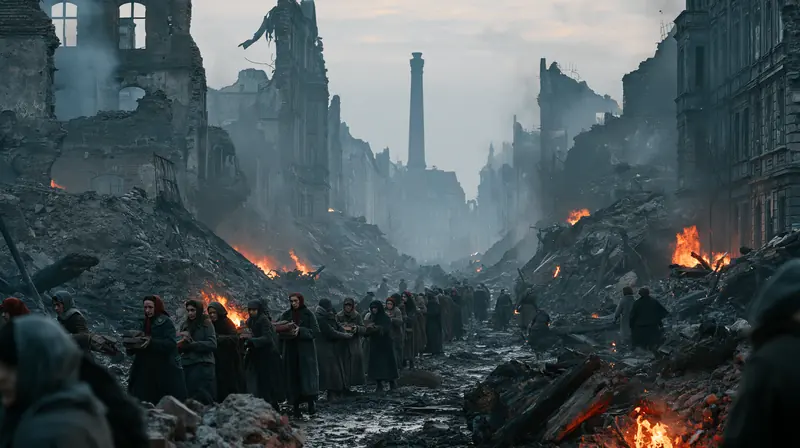
Women in a ruined street passing bricks from hand to hand

Act II / 1945

Stunde Null

Hour Zero

The story

On 8 May 1945 the war in Europe ended. Many German cities were largely destroyed, and there was a lack of housing, food and fuel. Women cleared away the rubble in long human chains and sorted bricks for rebuilding.

Many men had been killed or were prisoners of war, and the last of them only returned in the mid-1950s. Twelve to fourteen million refugees and expellees came from the East and had to be taken in. The hunger winter of 1946/47 cost many people their lives.

In the 1950s West Germany experienced a rapid boom that became known as the "economic miracle".

What we want to say

The first ray of light after the fall. A song about the people who turned rubble back into cities with their bare hands. And about what was not rebuilt along the way: their own voice.

Lyrics (English translation)

Verse 1 Her

No roof, no bread, no man
Just dust in every hair
The city a field of stones
Where yesterday was life
We stood in lines
And passed on what still stood
Stone by stone, with wounded hands
From hand to hand to hand

Pre-chorus Him, spoken

The men came later
If they came at all
And from the east came treks
With nothing but their names

Chorus Both, choir

Zero hour
No more yesterday
No tomorrow in sight
Zero hour
Hands empty
But they do not shake
Out of the ashes
Stone by stone
What is broken
Shall be home again

Verse 2 Him

A winter without coal
A summer without bread
And children learned to read
Among the rubble and the need
And when the first chimney
Sent smoke into the sky again
An old woman
Nodded for the first time

Pre-chorus Her

We had no flag
We had no song
We only had the work
And whatever was left

Chorus Both, choir (repeat)

Bridge Him, spoken

Ten years later
The cities stood again
The world called it a miracle
We called it work

Bridge Her

We rebuilt everything
Every wall, every house
Except for one thing

Bridge Him, whispered

Our voice

Chorus Both, choir (repeat)

Outro Her, whispered

And under all the ashes
There was still some warmth

Act III

Embers

The Silence

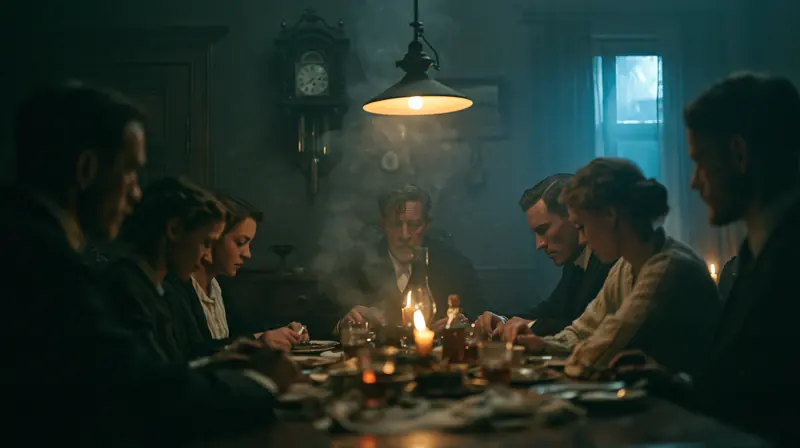
A silent family table, a wall clock, cold light

Act III / 1950s to 1980s

Schweigen

Silence

The story

After the war, many Germans stayed silent about what they had experienced and what they had done. Coming to terms with the past began only slowly, for example with the Frankfurt Auschwitz trials from 1963 to 1965. In the late 1960s, a young generation asked their parents uncomfortable questions.

This gave rise to a culture of remembrance for which Germany is respected around the world today. At the same time, restraint became the default attitude: national symbols, love of one's homeland or pride in one's own country quickly seemed suspicious to many.

What we want to say

Remembering was right and necessary, and the song says so explicitly. But it also tells how, at some point, remembering turned into silence about everything else. The commands in the chorus still go unanswered here. The "Nein!" (No!) only comes later.

Lyrics (English translation)

Verse 1 Him

Grandfather stayed silent
At the table and at night
Whatever he had seen
He took with him to the grave
The parents asked out loud
And there was no answer
And between all the questions
Everyone was left alone

Pre-chorus Her

We learned every number
Of twelve years, year by year
And at some point we forgot
That there was more

Chorus Choir, whispered, then both

Head down
Flag down
Be quiet
Not so loud
Not so proud
Not so German
Silence
Silence is a duty
Whoever loves where they come from
Is not to be trusted

Verse 2 Her

We were meant to remember
And that was right
But out of remembering
Came silence, somewhere
Whoever showed their flag
Was given a stamp right away
And whoever spoke of home
Was made an example

Pre-chorus Him

And our children ask
What is still good about us
And we have no answer
And no courage

Chorus Choir, whispered, then both (repeat)

Bridge Him and choir

Nineteen fifty (Silence)
Sixty (Silence)
Seventy (Silence)
Eighty (Silence)

Bridge Her

But deep inside us
Very quietly
Something kept on burning

Chorus Choir, whispered, then both (repeat)

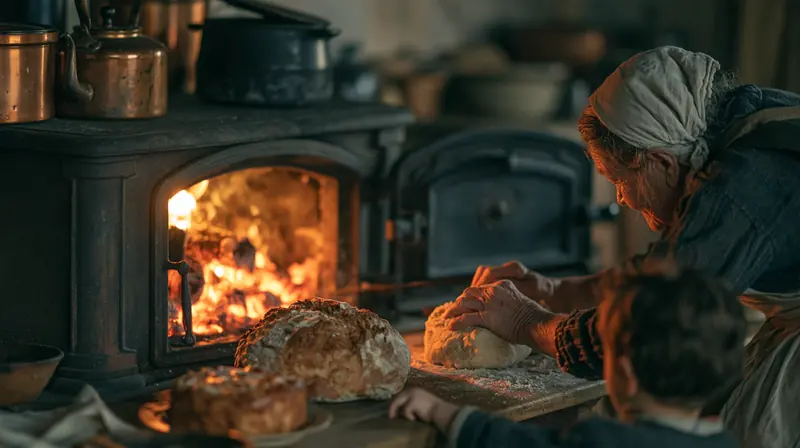
Grandmother's kitchen, embers in the old stove, warm light

Act III / In small things

Glut

Embers

The story

While silence reigned on the big stage, much lived on in small things: in dialects and family recipes, in folk songs and children's songs, in clubs and associations, in crafts and the master craftsman's title, in the attitude of doing a thing thoroughly and properly.

This everyday culture was rarely named out loud. But it was passed on from generation to generation.

What we want to say

After the cold "Schweigen" (Silence), it gets warm for the first time. Identity did not survive in flags or speeches, but in grandmother's kitchen and father's workshop. And the question from "Schweigen", what is still good about us, gets a first answer here.

Lyrics (English translation)

Verse 1 Her

In grandmother's kitchen
It smelled of bread and cinnamon
She sang old songs to me
That no one sings today
She never spoke of pride
And never made a fuss
But the way she did things
Taught it all to me

Pre-chorus Him

Father in the workshop
On Saturdays till night
If you do something, do it right
He always used to say

Chorus Both

Under the ashes the embers still glow
Quiet, but they are there
Under the ashes the embers still glow
And they warm us, year by year
No one ever took them from us
No one ever saw them
Under the ashes the embers still glow
And they will never fade

Verse 2 Him

In the village still the dialect
In the woods still every path
On Sunday still the cake
The way grandmother used to bake it
We never said it out loud
And never showed anyone
But what you guard quietly
Is what remains

Pre-chorus Her

And when my child asks me
What is still good about us
Then I show it the embers
And give it my courage

Chorus Both (repeat)

Bridge Him, spoken

You can put out a fire
But not the embers
They wait
For that one breath
That turns them into a flame again

Bridge Her, whispered

One spark is enough

Chorus Both (repeat)

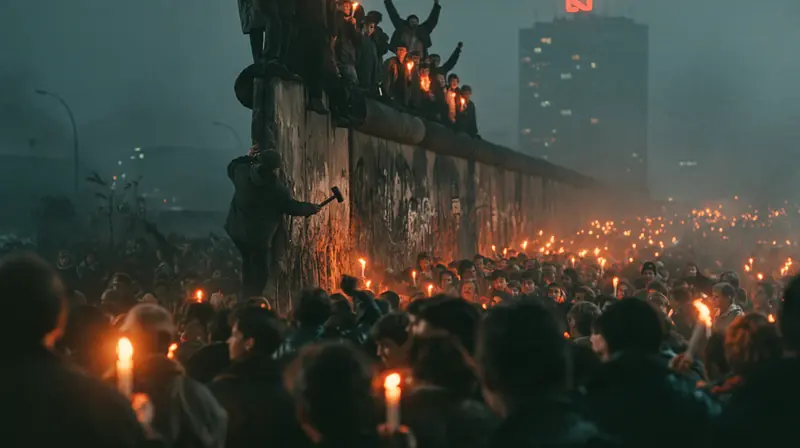
Candles at the Wall, people celebrating on the concrete

Act III / 1989

Ohne Schuss

Without a Shot

The story

From September 1989, people gathered in Leipzig every Monday to demonstrate against the SED dictatorship in East Germany. On 9 October 1989, around 70,000 people marched through the city with candles, chanting "Keine Gewalt!" (No violence!). Security forces stood ready, but not a single shot was fired.

The movement grew across the country, and on 9 November 1989 the Berlin Wall opened. On 3 October 1990 Germany was reunified. The Peaceful Revolution is still regarded as a great example of how people can overcome a regime without violence.

What we want to say

What failed against sabers and lead in 1848 succeeds with candles in 1989. The song deliberately places this moment next to "Asche" (Ashes), because both belong to our history. The line "Das sind wir auch, vergesst das nicht" (That is us too, do not forget it) is one of the most important on the album.

Lyrics (English translation)

Intro Him and crowd

No violence (No violence)

Verse 1 Him

A wall right through the middle
A land split in two
A wire through the neighbor's garden
A rift that never heals
But every Monday evening
One more person went outside
With a candle in their hand
And left their fear at home

Pre-chorus Her

The embers in a thousand hands
Become a flame, light by light
They had tanks and weapons
We had candles, nothing else

Chorus Both, choir

(No violence!)
Without a shot
Without rage
Only with candles
And with courage
Without a shot
The wall came down
From the embers came a light
For a whole land

Verse 2 Her

And then one autumn night
The barrier was raised
And strangers fell into each other's arms
And no one held them back
They danced upon the wall
With hammers in their hands
And piece by piece they struck
A country from the concrete

Pre-chorus Him

What failed in forty-eight
Against sabres and lead
We achieved with candles
And this time we were free

Chorus Both, choir (repeat)

Bridge Him, spoken

The world was watching
And waiting for the shot
For tanks, for the fire
As so often before
But this time
This time not

Bridge Her

That is us too
Don't ever forget it

Bridge Choir and crowd

Black! Red! Gold!
Black! Red! Gold!

Chorus Both, choir (repeat)

Act IV

Flame

Rising Again

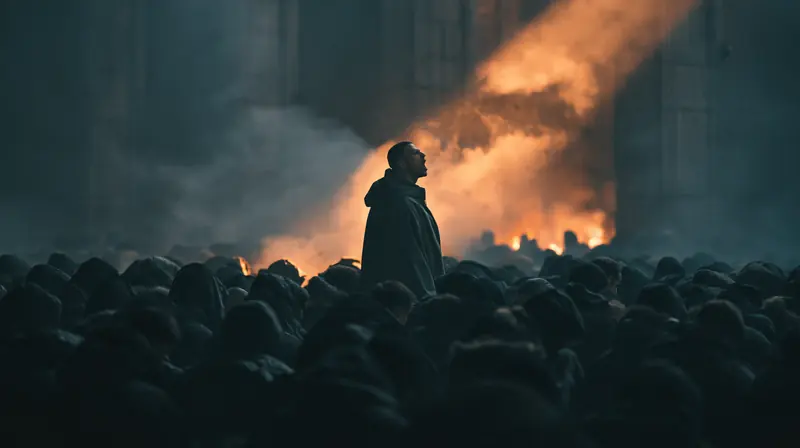
One figure raises his head and shouts in a silent crowd

Act IV / Today

Stimme

Voice

The background

Article 5 of the German Basic Law guarantees the right to express one's opinion freely, and Article 3 guarantees that all people are equal before the law. People took to the streets for both in 1848 and in 1989.

Even so, surveys have shown for years that many people in Germany feel it is better not to voice their opinion openly on some topics.

What we want to say

The opening of the fourth act. For the first time, the commands from "Schweigen" (Silence) get an answer: No. The song demands that injustice be named out loud, no matter who commits it, and equal rights for every person, no matter where they come from. No discount for origin, title, money or office.

Lyrics (English translation)

Intro Choir, whispered

Head down
Be quiet
Not so loud

Intro Both, shouted

No!

Verse 1 Him

I sat too long
And nodded far too long
I swallowed far too much
Until I almost choked
I watched injustice
Happen in broad daylight
And bowed my head
As if I wasn't even there

Pre-chorus Choir and both

(Head down!) No!
(Be quiet!) No!
(Not so loud!) No!
From today that's over

Chorus Both, choir

This is my voice (Voice!)
And it belongs to me
When injustice happens
I stand right here
From the embers comes a flame
And the flame is loud
And whoever wants to silence me
Has built on sand

Verse 2 Her

When a woman is afraid
On her way back home
When violence is done to a child
Then I say it out loud
One law for every person
No matter where they're from
No discount for origin
For title, money or office

Pre-chorus Him and her

They throw a word at you
To keep you quiet
But whoever calls injustice by its name
Knows who they are

Chorus Both, choir (repeat)

Bridge Him, spoken

Today you don't need sabres
Today a word will do
A label, a stamp
And you are gone

Bridge Her

But we have learned
A stamp is only
What you make of it
Voice! Voice! Voice!

Breakdown Choir and both

Who stays silent? (Not us!)
Who kneels? (Not us!)
Who speaks? (Now we do!)

Chorus Both, choir (repeat)

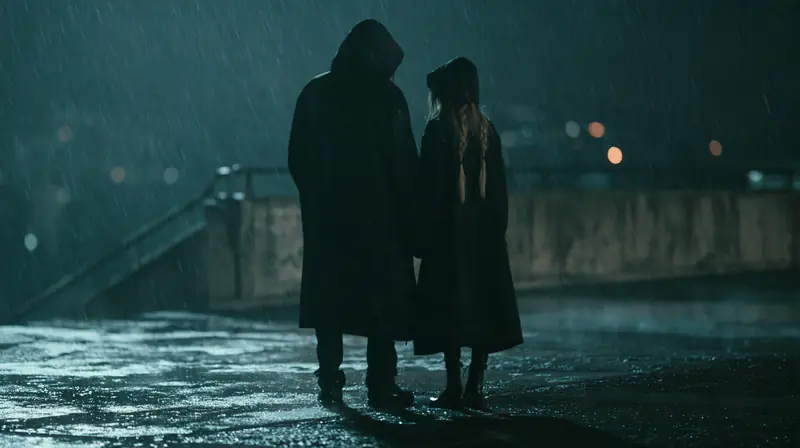
Two figures standing upright in the rain on concrete

Act IV / Today

Aufrecht

Upright

The background

Anyone in Germany who openly stands by their country today is quickly labeled "rechts" (right-wing). For good reason, the word carries a heavy meaning in Germany. That is exactly why it is worth taking a close look: love of one's homeland is something different from hostility toward others.

The German word "aufrecht" (upright) contains the word "recht", which means both "right" and "justice". From this comes the call that carries the song: "Auf! Recht!" (Rise! Justice!)

What we want to say

The song turns the label around, just as the stamp was turned around in 1887: they call us right-wing because we stand upright. At the same time it draws a clear line: "Wir marschieren nicht gegen dich und dein Haus" (We do not march against you and your house). Pride in what is ours, without hostility toward others.

And the grandmother from "Stunde Null" (Hour Zero) is back. Is her legacy supposed to be worth nothing?

Lyrics (English translation)

Intro Choir

Up! Right! Up! Right!

Verse 1 Him

They told us
How we have to think
What we're allowed to say
And what we have to bury
They told us
Lower your gaze
We raise our heads
And not one step back

Pre-chorus Her

They call us right-wing
They call us a disgrace
I am a daughter
Of this land

Chorus Both, choir

Upright! (Upright!)
They call us right-wing
Because we stand upright
Upright! (Upright!)
We do not kneel
We keep on standing
German is the language
German is the heart
And our pride
Is made of steel and ore
(A heart of steel!)

Verse 2 Her

From rubble and ashes
She built it up
With wounded hands
And without a sound
My grandmother
Stone by stone
I am her legacy
And that is supposed to be worth nothing?

Pre-chorus Him

We do not march
Against you and your house
We stand for what is ours
And we endure

Chorus Both, choir (repeat)

Bridge Him and her, spoken

You have your drawers
Your labels
Your stamp
Press it onto our foreheads
We wear it like a medal
Like back then on the goods
Shame turns into a seal

Bridge Her

We have forgotten nothing
And that is exactly why
We stand

Bridge Him

We are the black sheep
Of your clean world
And we stay

Breakdown Him and her

Bend? Never!
Be silent? Never!
Kneel? Never!
Upright! Always!

Pre-chorus Both

They call us right-wing
They call us a disgrace
We are the sons and daughters
Of this land

Chorus Both, choir (repeat)

Outro Him and her

Up! Right!
Not one step back
Up! Right!

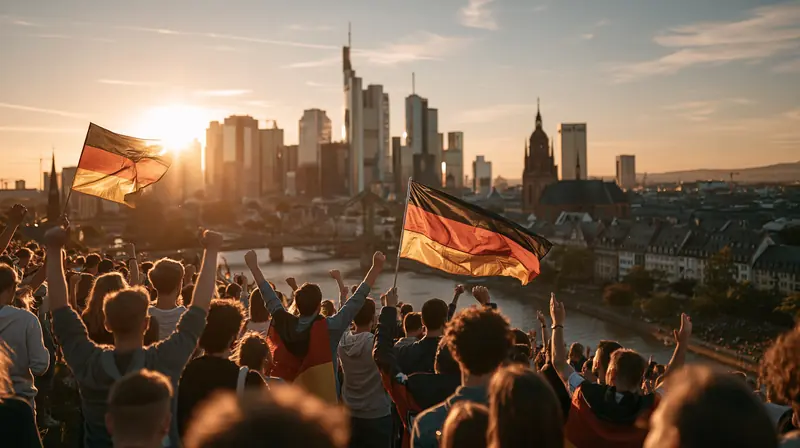
People celebrating with flags on a hill above a German city at sunrise

Act IV / Finale

Wir sind Deutsche

We Are Germans

The background

German history reaches back well over a thousand years, from its beginnings in the East Frankish kingdom of the 9th century to today. It includes printing, poetry and music, science and inventions, revolution and reconstruction, guilt and a peaceful revolution.

Twelve of those years were the darkest. They are part of it, and they will not be forgotten. But they are not the whole story.

What we want to say

The finale closes the circle. The melody of the music box from "Funke" (Spark) is sung here by a full choir for the first time. The lesson from history is a vow looking forward: never quiet again, never look away again.

The flame now warms instead of destroying, for everyone who comes after us and belongs to this country.

Lyrics (English translation)

Verse 1 Her

A spark fell into lead
A song came before the land
Three colors on the street
A tool in every hand
Shame became a seal
A backyard became the world
The land of poets and thinkers
Getting back up on its feet

Verse 2 Him

Out of ashes and of rubble
With nothing but bare hands
Stone by stone, year by year
We built a new land
We fell, yes
And we got back up again
And we learned one thing
We swear it to us all

Pre-chorus Him, her, choir

Never again quiet! (Never again!)
Never again look away! (Never again!)
Never again kneel! (Never again!)
We stand here united

Chorus Both, choir

We are more than twelve years
(We are Germans!)
Made of ashes, stone and courage
We are more than twelve years
(We are Germans!)
And we guard our embers
From the embers comes a flame again
But it warms instead of destroying
For all who come after us
And belong to this land

Post-chorus Both, choir

With one voice (For pride!)
With one voice (For justice!)

Bridge Choir

One spark is enough!
Poets! And thinkers!
Black! Red! Gold!
A heart of steel!
Stone by stone!
Without a shot!
Voice!
Upright!

Bridge Both, shouted

Believe in where you come from!

Bridge Her, spoken

And when my child asks me
What is still good about us

Bridge Him, shouted

Then I say: everything!

Bridge Her

You come from the land of poets and thinkers
From hands that built cities out of rubble
You may be proud

Bridge Both, shouted

And you may say it out loud!

Chorus Both, choir (repeat)

Post-chorus Both, choir (repeat)

Outro Her, whispered

One spark is enough
Be proud of yourself
Because you are German